
Becoming a flight attendant is one of the most popular career goals among aviation aspirants in Bahrain, and it’s easy to see why: international travel, competitive pay, and the chance to represent an airline brand to travellers from around the world. But recruitment for this role is genuinely competitive, and airlines flying out of Bahrain and across the Gulf are selective about who makes it through. At Akbar Training Center, an IATA authorized training centre in Bahrain, we’ve guided many aviation aspirants through the preparation process, and this guide lays out exactly what that process looks like, step by step.
If you’re only exploring the role right now, our earlier guide on cabin crew training in Bahrain is a good primer. This article goes further, walking you through the actual steps from eligibility to your first day of airline-issued safety training.
What It Takes to Become a Flight Attendant
There’s no single shortcut into this career, but there is a reliable order of operations that genuinely improves your odds. The steps below reflect what we see work consistently for candidates in Bahrain: understanding the role honestly, meeting the baseline eligibility criteria, building real customer service competence, and only then moving on to applications and interviews. Follow them in sequence rather than jumping straight to Step 6.
Step 1: Understand What the Role Actually Involves
Before investing time and money into preparation, it’s worth understanding what the job really is. A flight attendant’s primary responsibility is passenger safety, not hospitality — service is important, but it sits second to emergency preparedness, evacuation procedures, and inflight security. Recruiters are trained to spot candidates who see the role purely as glamorous travel, so genuinely understanding the safety-first nature of the job is your first real step.
Step 2: Check Your Eligibility
Requirements differ slightly across airlines, but candidates in Bahrain applying to Gulf and international carriers should generally expect the following baseline:
- Minimum age of 18 to 21 years, depending on the airline
- High school diploma or equivalent; a diploma in travel, tourism, or hospitality strengthens your profile
- Fluency in English; Arabic is a strong advantage for Gulf-based carriers, and additional languages are a bonus
- Minimum height and arm-reach requirements (varies by aircraft type and airline)
- Good physical fitness and the ability to pass a medical examination
- A clean employment and, in most cases, police clearance record
- No visible tattoos in uniform (airline policy dependent)
If you meet these basics, the next steps are about becoming a genuinely competitive applicant, not just an eligible one.
Step 3: Build Your Customer Service Foundation
This is the step most self-taught applicants skip, and it’s usually why they don’t clear assessment days. Airlines don’t just want friendly people; they want candidates who can de-escalate a frustrated passenger, manage a language barrier, and stay composed when a flight is delayed for the third time. This is a learnable skill set, not a personality trait, which is exactly why we built our Serving the Travel Customer course around it. It covers customer handling, loyalty building, and conflict resolution scenarios specific to the travel industry, and it’s the single most useful starting point for anyone serious about cabin crew recruitment in Bahrain.
Step 4: Strengthen Your Aviation and Travel Industry Knowledge

Once your service fundamentals are solid, build airline-specific knowledge that sets you apart in interviews. Our IATA Airline Customer Service course focuses specifically on cross-cultural passenger management within an airline context.
Candidates who can speak knowledgeably about the industry during a panel interview consistently stand out from those relying on enthusiasm alone. That’s where a broader qualification helps: the IATA Foundation in Travel and Tourism Diploma builds fluency in ticketing, travel documentation, and global aviation operations, and gives recruiters a clear signal that you understand how the industry actually works, not just how to smile through a delay.
Step 5: Prepare Your Grooming, Documents, and Interview Skills
With your training foundation in place, shift focus to recruitment logistics:
- Prepare a professional CV with a recent, uniform-style photograph
- Keep your passport, educational certificates, and medical records ready and up to date
- Practice airline grooming standards: hair, makeup, and uniform-appropriate presentation
- Rehearse common interview questions, especially around handling difficult passengers and teamwork
- Practice group discussion exercises, since most airline assessment days include one
Step 6: Apply to Airlines Recruiting From Bahrain and the GCC
Bahrain’s location makes it a strong base for candidates targeting Gulf Air and other regional and international carriers that regularly hold open days or recruitment drives across the GCC. Keep an eye on airline career pages and recruitment agency listings, and apply broadly rather than waiting for a single preferred airline.
If cabin crew openings are limited when you’re ready to apply, the same training also qualifies you for related aviation roles worth considering in the meantime — our guides on airport careers in Bahrain and best careers in the airline and airport industry outline several options.
Step 7: Pass the Assessment Day
Airline assessment days typically include a height and reach check, group exercises, a face-to-face interview, and sometimes a swim test for airlines requiring water safety competence.
This is where formal training pays off directly: candidates who’ve completed structured customer service coursework tend to perform noticeably better in group exercises, because they’ve already practiced staying composed and collaborative under pressure rather than improvising for the first time in front of recruiters.
Step 8: Complete Airline-Issued Safety Training
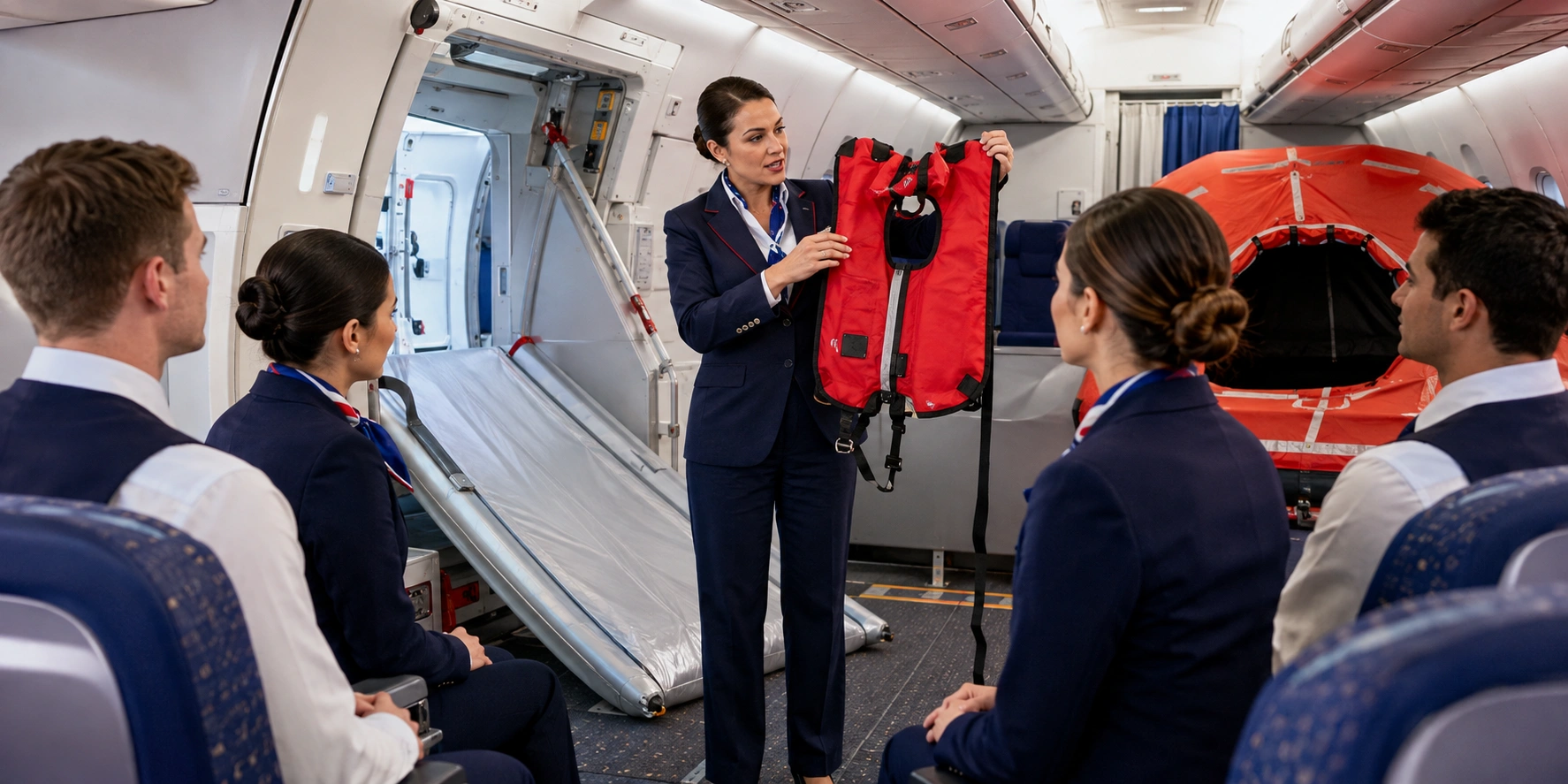
If you’re successful, the airline itself will put you through Safety and Emergency Procedures (SEP) training, covering evacuation drills, firefighting, first aid, and security protocols. This certification is airline-specific and cannot be completed in advance through an external institute, which is why steps 1 through 7 exist: they’re about becoming the strongest possible candidate before you ever reach this final stage.
Conclusion
Becoming a flight attendant isn’t about luck or a good photo — it’s about walking into an assessment day already prepared in the ways that matter: composed, knowledgeable, and genuinely skilled at handling people. Candidates who take the time to build a real customer service and industry foundation, rather than relying on enthusiasm alone, are consistently the ones who make it through. If you’d like a deeper look at what that foundation involves before you commit, our guide on what the IATA Foundation course covers is a useful next read.
Start where it counts, be patient with the process, and treat every application as practice for the next one. Bahrain’s aviation industry is growing, and prepared candidates are the ones who benefit from it.
Related Courses at Akbar Training Center in Bahrain
Akbar Training Centre in Bahrain is an IATA-authorized global training partner offering comprehensive coaching for students aspiring for a career in aviation and travel. Courses most relevant to becoming a flight attendant include:
- Serving the Travel Customer Certification
- IATA Airline Customer Service Course
- IATA Foundation in Travel and Tourism Diploma with Sabre GDS / Amadeus GDS training
- IATA Cargo Introductory Diploma
- Managing the Travel Business Diploma
If you’re still deciding between career paths, our guides on becoming a travel agent in Bahrain, IATA training fees and career paths in Bahrain, and the IATA Cargo course benefits and career opportunities are worth comparing before you commit.