
Table of Contents
ToggleWhat Is IATA BSP Accounting? Modules, Billing, Remittance and Settlement
If you work in the tourism industry or aspire to make a career in the airlines sector, then you must have come across the term “BSP Accounting” at least once in your life. But what does this term mean? Why is everyone in the aviation industry talking about it?
BSP stands for the Billing and Settlement Plan of the International Air Transportation Association, or the IATA Billing and Settlement Plan. The IATA Billing and Settlement Plan provides the very essence of accounting in relation to the dealings between airlines and their agents all around the world. The complexity of the billing procedure is eliminated by means of BSP accounting, which makes the whole process much quicker, easier, and efficient.
This blog will provide you with all that is necessary to know about IATA BSP Accounting – starting with its basic modules, billing system, remittance and settlement process, in the simplest way possible.
What Is IATA BSP Accounting?
IATA BSP Accounting is a standardized financial system developed by the International Air Transport Association (IATA) to manage and streamline transactions between airlines and travel agents. It handles everything from ticket sales reporting to billing, remittance, and final settlement. Instead of each airline managing payments separately, BSP creates one unified platform — saving time, reducing errors, and bringing complete financial transparency to the aviation industry.
How Does the IATA BSP Accounting System Work?
The IATA BSP Accounting system follows a clear and simple step-by-step process that connects airlines, travel agents, and payments in one unified platform.
Airline Issues Ticket Authority: The airline grants ticketing authority to registered travel agents. This permission allows agents to issue official airline tickets on behalf of the carrier through approved GDS platforms.
Travel Agent Sells Ticket: The travel agent books and issues the flight ticket to the passenger through a GDS like Amadeus, Sabre, or Galileo. The transaction is automatically recorded in the system.
BSP Records Transaction: Every ticket issued by the agent is automatically captured and stored in the BSP database. This ensures complete accuracy and transparency for both the airline and the travel agent.
Billing Generated: At the end of each billing cycle — weekly or bi-monthly — BSP generates a consolidated billing statement showing all ticket sales, refunds, ADMs, and ACMs for the agent.
Remittance: The travel agent reviews the billing statement and submits the total payment to IATA by the due date. This single payment covers all airlines the agent has sold tickets for.
Settlement: IATA distributes the collected funds to each respective airline accurately and on time. Every airline receives one consolidated payout covering all agent sales made during that billing cycle.
This entire process happens automatically through BSPlink — making airline and agent financial management faster, more accurate, and completely transparent across the global aviation industry.
Key Components of IATA BSP Accounting
IATA BSP Accounting is built on three core components that work together to keep airline and travel agent finances accurate, transparent and efficient at every stage of the payment process.
BSP Billing
BSP Billing runs on a weekly or fortnightly billing cycle depending on the market. At the end of each cycle, the system generates a consolidated billing statement showing all ticket sales and refunds through detailed sales reporting for every registered travel agent.
BSP Remittance
BSP Remittance is how travel agents pay their dues to IATA. Each payment cycle has clearly defined due dates that agents must meet. Payment is made through a direct bank transfer — covering all airline sales in one single consolidated transaction instead of paying each airline separately.
BSP Settlement
Once remittance is received, IATA processes the clearing payments and distributes the correct amount to each airline. Airlines receive money in one consolidated payout covering all agent sales. A final reconciliation is then completed to ensure every transaction has been accurately accounted for and matched.
IATA BSP Accounting Course Modules
The IATA BSP Accounting course is built around three official modules. Here is a detailed breakdown organized by the five core areas they cover:
IATA BSP Accounting Course Modules
The IATA BSP Accounting course is built around three official modules that cover everything from billing reports to standard documents and full IATA compliance procedures.
Module 1 – BSP Agent Billing Reports and Procedures
- BSP Billing Reports — Learn how to read, interpret and verify complete billing reports generated by BSP for every travel agent account.
- HOT Files — Understand how HOT files deliver final processed accounting data back to airlines for accurate reconciliation after every billing cycle.
- Agent Billing Analysis — Analyse agent billing statements in detail to identify errors, discrepancies and outstanding amounts before the remittance deadline arrives.
- Billing Cycle — Learn how weekly and bi-monthly billing cycles work and how deadlines affect agent payment obligations within the BSP system.
- Ticket Reporting — Understand how every issued ticket gets automatically reported into the BSP system through GDS platforms like Amadeus and Sabre.
- ADM — Learn how airlines issue Agency Debit Memos to recover underpaid amounts or apply penalties against travel agents for ticketing errors.
- ACM — Understand how Agency Credit Memos are issued to agents as refunds or corrections after a successfully disputed ADM case.
- Practical Examples — Apply real billing scenarios and case studies to understand how BSP billing works in actual airline and agency environments.
Module 2 – BSP Agent Remittance Procedures
- Remittance Calendar — Learn how to read and follow the official BSP remittance calendar to ensure payments are always submitted on schedule.
- Payment Process — Understand the complete step by step process of how agents consolidate and submit their total dues to IATA on time.
- Due Dates — Learn how BSP remittance due dates are set, how to track them accurately and what happens when deadlines are missed.
- Default Prevention — Understand how to avoid payment defaults, maintain clean payment records and protect your agency’s ticketing rights within BSP.
- Remittance Reports — Learn how to generate and verify remittance reports to confirm payments have been received and processed correctly by IATA.
- Payment Methods — Explore available BSP payment methods including BSP Cash, Customer Card payments and the IATA EasyPay prepaid e-wallet solution.
- Bank Procedures — Understand how direct bank transfers and debit procedures work when submitting consolidated remittance payments through the BSP system.
Module 3 – BSP Standard Documents and Procedures
- Standard Traffic Documents — Learn about all official IATA standard traffic documents used in airline ticketing, sales reporting and BSP transaction processing globally.
- Electronic Tickets — Understand how e-tickets are issued, stored and reported through the BSP system using GDS platforms and BSPlink portal.
- Refund Documents — Learn how to correctly prepare, submit and process passenger refund requests and refund applications through the official BSP procedures.
- Exchanges — Understand how ticket exchanges and rebooking processes are handled, documented and reported accurately within the BSP accounting system.
- ADM — Learn the correct procedure for raising, responding to and resolving Agency Debit Memos in full compliance with IATA guidelines.
- ACM — Understand how Agency Credit Memos are issued, processed and recorded as part of standard BSP document management procedures.
- Supporting Documentation — Learn what supporting documents are required for billing disputes, refunds, exchanges and ADM or ACM resolution processes.
- IATA Compliance — Understand how to maintain full compliance with IATA BSP rules, reporting standards and documentation requirements at all times.
Also Read: IATA Cargo Course: Benefits, Syllabus, Fees & Career Opportunities
Common BSP Reports Every IATA Accountant Should Know
Every IATA accountant works with a specific set of BSP reports daily. Knowing these reports well makes your work faster, more accurate and completely error free.
- Billing Analysis Report — Shows complete breakdown of all ticket sales, refunds, ADMs and ACMs processed during each billing cycle for every agent.
- HOT File — Delivers final processed accounting data from BSP directly to airlines for accurate reconciliation after every completed billing cycle ends.
- Agent Analysis Report — Provides detailed overview of individual agent sales performance, transaction history and outstanding balances within a specific BSP billing period.
- Remittance Report — Confirms all payments submitted by travel agents to IATA and verifies that remittance has been received and processed correctly.
- Refund Report — Tracks all passenger refund requests submitted through BSPlink and shows their current approval, rejection or pending processing status clearly.
- ADM Report — Lists all Agency Debit Memos raised by airlines against agents for fare errors, commission issues or ticketing policy violations.
- ACM Report — Records all Agency Credit Memos issued to agents as corrections or refunds after successful ADM disputes or overpayment adjustments.
Common BSP Accounting Terms Explained
If you are new to BSP Accounting, these terms will appear constantly in your daily work. Here is a quick and simple reference guide to the most important BSP accounting terms you must know.
| Term | Full Form | Simple Meaning |
|---|---|---|
| BSP | Billing and Settlement Plan | A global system that manages financial transactions between airlines and travel agents. |
| ADM | Agency Debit Memo | A bill raised by an airline to recover underpaid amounts or penalties from a travel agent. |
| ACM | Agency Credit Memo | A credit note issued by an airline to refund or correct an overcharged amount to an agent. |
| HOT File | Hand-Off Tape File | A processed data file that delivers final billing information from BSP to airlines for reconciliation. |
| GDS | Global Distribution System | A computerized platform like Amadeus, Sabre, or Galileo used by agents to issue airline tickets. |
| BSPlink | BSP Online Portal | The official IATA online platform where agents and airlines manage all BSP transactions and reports. |
| Remittance | Payment by Agent | The consolidated payment submitted by a travel agent to IATA covering all airline ticket sales. |
| Settlement | Final Payment to Airline | The process where IATA distributes collected agent payments to each respective airline accurately. |
Skills Required for IATA BSP Accounting
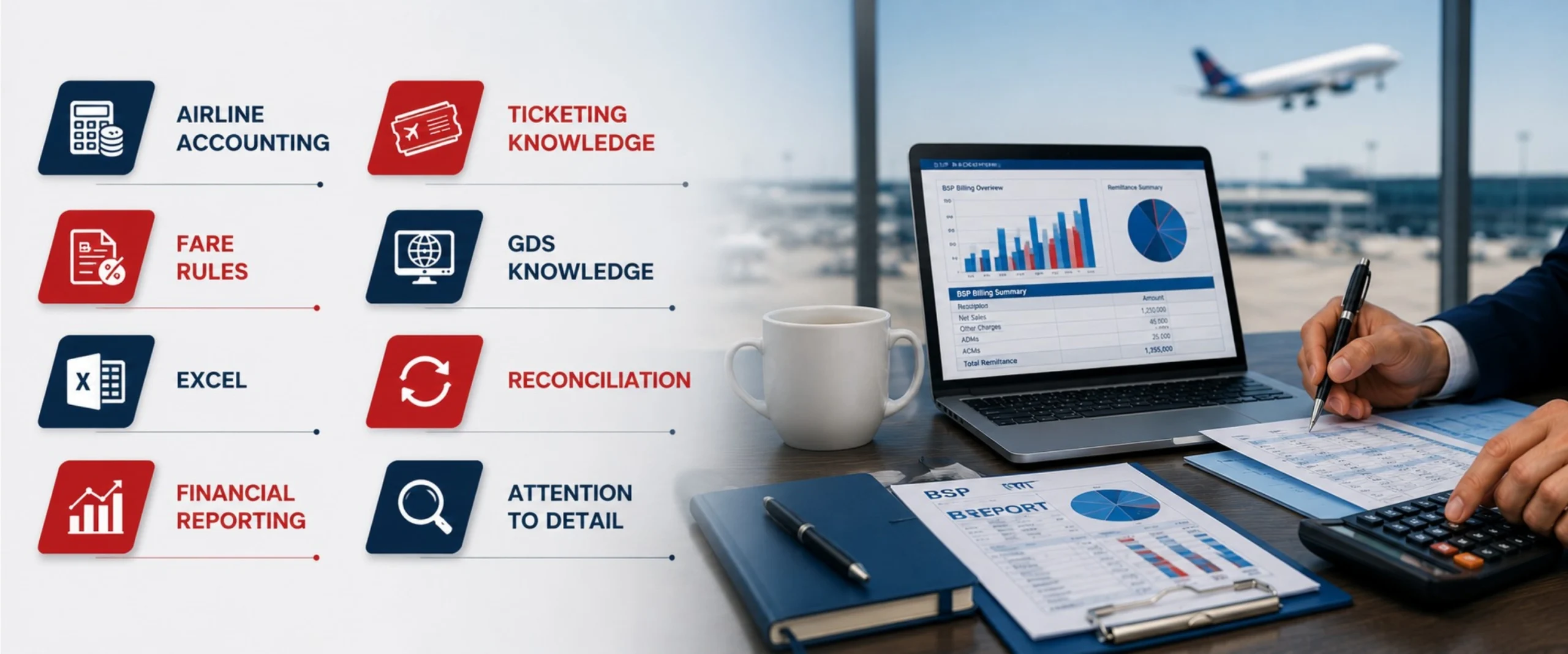
To build a successful career in BSP Accounting, you need a combination of technical and analytical skills that help you handle airline financial transactions accurately, efficiently and in full compliance with IATA standards every single day.
- Airline Accounting
- Ticketing Knowledge
- Fare Rules
- GDS Knowledge
- Excel
- Reconciliation
- Financial Reporting
- Attention to Detail
The good news is that all these skills can be learned and developed through the right training program. At Akbar Training Center Bahrain, our IATA BSP Accounting course is designed to build every single one of these skills practically and confidently.
Also Read: IATA Training in Bahrain: Course Fees, Certification Costs & Career Paths
Career Opportunities After Learning BSP Accounting
Entry-Level Roles
- Accounts Officer — Responsible for maintaining accurate financial records, processing payments, reconciling BSP reports and supporting the finance team within airlines or travel companies.
- Airline Back Office Executive — Manages behind-the-scenes airline financial operations including ticket revenue processing, BSP report verification, reconciliation and documentation for smooth daily operations.
Mid-Level Roles
- BSP Executive — Specializes in managing BSP transactions, verifying billing statements, processing remittance payments and resolving ADM and ACM disputes for travel agencies.
- Travel Finance Executive — Oversees financial operations of travel agencies including BSP billing, payment processing, reconciliation and ensuring full compliance with IATA remittance deadlines.
- Airline Accountant — Handles complete airline financial records, ticket revenue tracking, reconciliation and reporting to ensure accurate and compliant airline accounting operations daily.
- IATA Accountant — Manages all BSP financial transactions, billing reports, remittance processing and settlement procedures for airlines and travel agencies using IATA standards.
- Airline Revenue Executive — Monitors ticket sales, revenue performance, fare structures, and financial reports to maximize airline profitability.
Senior-Level Roles
- Revenue Accountant — Monitors and analyzes airline ticket sales, fare revenues, refunds and financial performance data to maximize overall airline revenue and profitability.
- BSP and Compliance Manager — Supervises BSP operations, regulatory compliance, financial audits, and risk management to maintain smooth airline and agency partnerships.
- Airline Finance Manager — Directs financial planning, budgeting, revenue management, and settlement processes within airline organizations.
Benefits of IATA BSP Accounting
Learning IATA BSP Accounting gives you a real and lasting advantage — both in your career growth and in your daily professional work across airlines, travel agencies and aviation finance departments.
Career Benefits
- High Demand Skill — BSP knowledge is actively sought by airlines and travel agencies across Bahrain, GCC and internationally right now.
- Better Salary Opportunities — Professionals with BSP certification consistently earn higher salaries compared to non certified candidates in similar roles.
- Airline Jobs — BSP knowledge directly qualifies you for revenue accounting, finance and back office roles inside major airlines globally.
- Travel Agency Jobs — Every IATA registered travel agency needs BSP trained professionals to manage billing, remittance and settlement accurately.
- International Opportunities — IATA BSP certification is recognized in 190+ countries opening career doors far beyond Bahrain and the GCC region.
- Better Accounting Knowledge — BSP training builds deep practical accounting skills that go beyond textbooks and apply directly to real aviation finance work.
- Professional Growth — BSP knowledge accelerates your promotion timeline and positions you for senior finance and accounting roles much faster.
Professional Benefits
- Simplifies billing and payment processes between airlines and travel agents significantly.
- Improves financial accuracy and transparency across all ticket sales and settlements.
- Ensures timely remittance and settlement within every BSP billing cycle.
- Reduces administrative workload and eliminates common errors in financial reporting.
- Streamlines reconciliation and reporting making daily accounting work faster and cleaner.
- Enhances career opportunities across aviation travel and airline finance departments globally.
- Helps maintain full compliance with IATA standards and BSP regulations at all times.
- Increases operational efficiency for travel businesses handling high volumes of airline transactions.
Common Challenges in BSP Accounting
BSP Accounting is highly rewarding but it does come with real challenges. Knowing these challenges in advance helps you prepare better and handle them confidently in your daily work.
- Reporting Errors — Incorrect data entries in billing reports can cause major financial discrepancies between airlines and agents leading to costly reconciliation problems.
- Late Remittance — Missing BSP payment deadlines triggers an immediate Notice of Irregularity and can result in suspension of the agency’s ticketing rights.
- ADM Disputes — Airlines and agents often disagree on debit memo amounts leading to lengthy dispute processes that require strong documentation and IATA knowledge.
- Reconciliation Issues — Matching BSP billing reports with internal agency records is time consuming and errors can go undetected without proper daily monitoring systems.
- Refund Errors — Incorrectly processed refund applications cause financial losses and compliance issues for both travel agents and airlines within the BSP system.
- Compliance Mistakes — Failing to follow IATA BSP procedures and guidelines correctly can lead to penalties, irregularity notices and serious damage to agency reputation.
Best Practices for Accurate BSP Accounting

Following the right practices daily makes BSP Accounting significantly easier, more accurate and fully compliant. Here are the six most important habits every BSP professional must build from day one.
- Verify Reports Regularly — Always review your BSP billing reports carefully after every cycle to catch errors before they affect remittance or settlement processes.
- Meet Remittance Deadlines — Mark all BSP payment due dates on your calendar and submit payments on time to avoid irregularity notices or ticketing suspensions.
- Maintain Documentation — Keep complete and organized records of all tickets, refunds, ADMs, ACMs and payment confirmations for every BSP transaction you process.
- Monitor ADM and ACM — Review all debit and credit memos regularly, respond within IATA timelines and dispute any incorrect ADMs with proper supporting documentation.
- Reconcile Daily — Compare your internal agency records with BSP reports every single day to catch discrepancies early before they become bigger financial problems.
- Follow IATA Procedures — Always process every transaction strictly according to official IATA BSP guidelines to maintain full compliance and protect your agency’s ticketing rights.
Building these six habits consistently will keep your BSP operations accurate, compliant and completely error free — making you one of the most reliable and trusted professionals in any aviation finance team.
Start Learning IATA BSP Accounting Today
The IATA BSP Accounting course at Akbar Training Center Bahrain is a complete industry focused training program designed to give you real practical skills from day one. You will learn how to read and verify billing reports, follow correct remittance procedures, manage standard BSP documents and handle real world accounting scenarios with full confidence. Every module is taught by experienced aviation finance professionals using hands on learning methods.
Enroll today at Akbar Training Center — Bahrain’s only IATA Premier Circle Authorized Training Center — and take your first step toward a successful aviation finance career.
Conclusion
IATA BSP Accounting functions as a fundamental financial system which serves the worldwide travel sector. When you understand how BSP modules, billing, remittance, and settlement all connect, you become a more accurate, efficient, and confident professional in any travel or airline role.
BSP knowledge provides you with useful skills which will help you advance your finance or accounting career from entry-level to senior positions. The proper training along with appropriate guidance will enable you to develop a successful career path which lasts for many years within the aviation and travel industry.

Frequently Asked Questions
IATA stands for International Air Transport Association. BSP stands for Billing and Settlement Plan. Together, they form a global system that manages financial transactions between travel agents and airlines.
IATA-certified travel agencies along with their airline partners access BSPlink through a single login portal. The platform enables agents to view their payment statements and process refund requests while airlines use it to verify their ticket sales and create debit memos.
Late payments trigger an immediate Notice of Irregularity. If the agent does not pay quickly, the system can suspend their ticketing rights. This means they cannot issue any more airline tickets until the debt is cleared.
An Agency Debit Memo (ADM) is a bill sent by an airline to an agent to collect underpaid money or penalties. An Agency Credit Memos (ACM) is the opposite—it is a credit note given to an agent for an overpayment or a refund.
Yes! Airlines look for specialists to work in their revenue accounting, finance, and audit teams. Learning BSP gives you the exact practical skills needed for these well-paying roles.