Difference Between IATA and Non-IATA Aviation Training
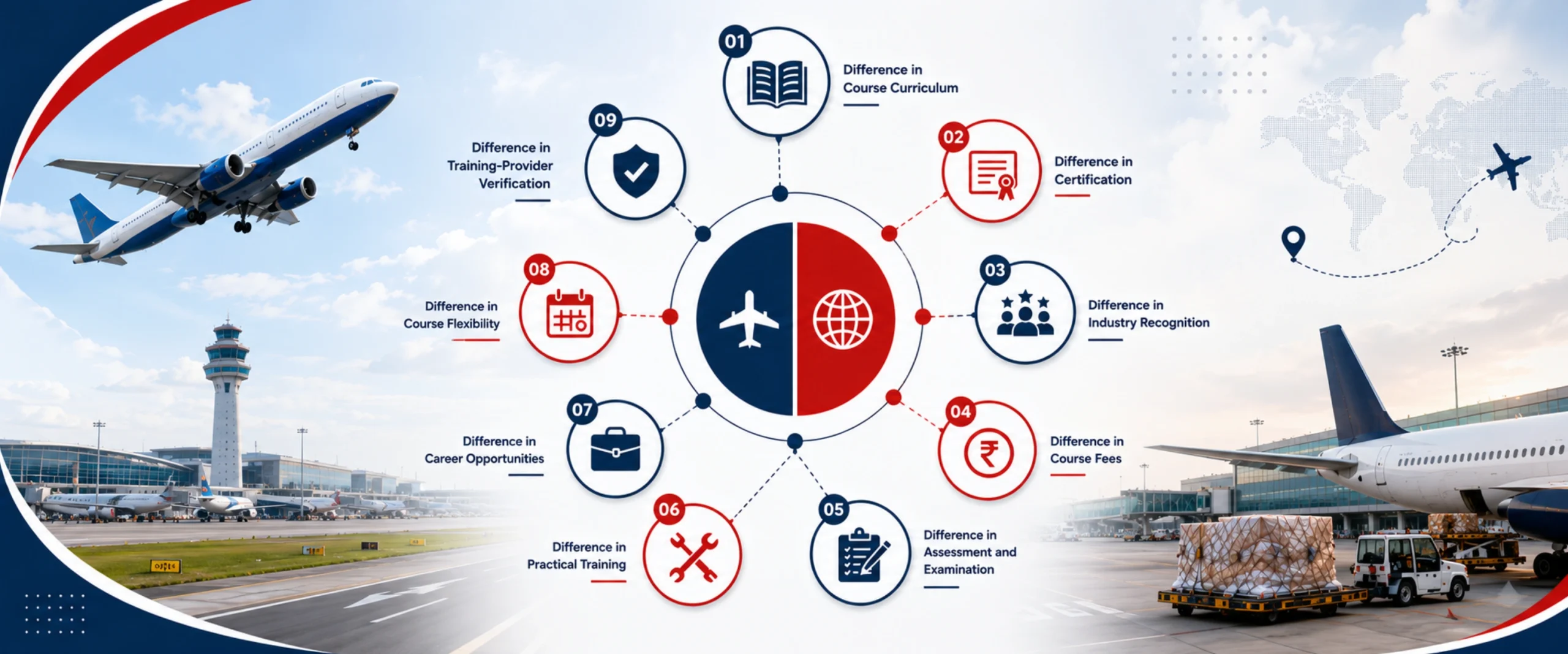
1. Difference in Course Curriculum
One major difference between IATA and non-IATA aviation training is the source and structure of the curriculum.
IATA courses use industry-focused content developed by subject specialists. The curriculum generally follows defined learning objectives, course materials, assessments, and completion requirements.
For example, IATA’s Foundation in Travel and Tourism course covers travel products, customer service, travel requirements, reservations, and global distribution system skills.
A non-IATA aviation institute creates its own syllabus or follows the curriculum of an affiliated university, skill council, airline, or government authority.
Such flexibility can be useful when the course is designed around local recruitment requirements. However, students should review the complete syllabus because course quality can vary considerably between institutions.
2. Difference in Certification
Students completing an eligible official IATA course and its required assessment receive the applicable IATA certificate, award, or diploma.
IATA also provides a certificate-verification facility for certain training certificates. For certificates issued after September 1, 2025, an authentic certificate may include a QR code leading to a verification screen containing the learner’s name, course title, and completion information.
Students completing non-IATA aviation training normally receive a certificate from the academy, college, university, airline, or affiliated organisation.
Before joining, students should ask:
- Who issues the final certificate?
- Can employers verify it?
- Is the institute recognised or affiliated?
- Does the certificate carry academic credit?
- Is it accepted for the intended job?
- Does it require periodic renewal?
A certificate should never be judged only by its design or the logos printed on it.
3. Difference in Industry Recognition
IATA qualifications are designed specifically for aviation, airline, cargo, and travel-industry professionals. IATA describes its travel and tourism qualifications as internationally recognised within the travel industry.
This recognition may be useful when applying to airlines, travel companies, cargo businesses, airport service providers, or international employers familiar with IATA programs.
The recognition of non-IATA training depends on the training provider. A course offered by a respected university, major airline, established academy, or regulator-approved institution may have strong employment value.
Therefore, the comparison should not simply be “international certificate versus local certificate.” Students must compare the relevance and credibility of the specific qualifications.
4. Difference in Course Fees
IATA course fees vary according to the subject, study method, training centre, location, examination requirements, and qualification level.
Official IATA training may cost more than many private certificate programs because it includes structured course materials, assessments, and an internationally recognised qualification.
Non-IATA aviation courses are available in a wider range of fees. Short-term airport or hospitality courses may be comparatively affordable, while university degrees and advanced airline programs can cost significantly more.
Students should compare the complete cost, including:
- Tuition fees
- Registration charges
- Examination fees
- Study materials
- Software training
- Uniform charges
- Internship expenses
- Certification fees
- Retake charges
- Accommodation and travel costs
A lower-priced course is not automatically better value if it lacks qualified trainers or practical exposure.
5. Difference in Assessment and Examination
IATA courses follow the examination or assessment conditions specified for the particular program. Some courses involve supervised examinations, while self-study courses may use online assessments.
IATA Authorised Training Centers guide learners through official material and manage applicable supervised examinations.
Non-IATA institutes decide their own assessment system. It may include:
- Written examinations
- Assignments
- Practical assessments
- Mock interviews
- Group discussions
- Attendance requirements
- Projects
- Internal examinations
Before enrolling, students should understand whether the course requires only attendance or a genuine evaluation of skills.
6. Difference in Practical Training
An IATA certificate confirms completion of a defined IATA training program, but practical exposure varies according to the course and delivery provider.
Some courses focus on theoretical and operational knowledge, while others include case studies, exercises, software training, or instructor-led activities.
Non-IATA programs may include practical elements such as:
- Airport visits
- Mock check-in counters
- Reservation-system practice
- Cabin service demonstrations
- Grooming sessions
- Communication exercises
- Internship opportunities
- Interview simulations
Students should assess practical training separately from certification. A recognised certificate and strong hands-on preparation are both valuable, but they are not always provided together.
7. Difference in Career Opportunities
IATA training can be particularly relevant for careers in:
- Travel consultancy
- Airline ticketing
- Reservations
- Air cargo
- Dangerous goods handling
- Airport and ground operations
- Airline customer service
- Aviation safety
- Revenue management
- Airline and airport management
IATA offers qualifications ranging from entry-level travel training to specialised aviation and management diploma programs. Its diploma programs generally combine required and elective courses according to the selected specialisation.
Non-IATA aviation courses may prepare students for roles such as:
- Airport ground staff
- Guest service associate
- Customer service executive
- Cabin crew applicant
- Ticketing assistant
- Travel desk executive
- Tourism coordinator
- Airport retail employee
- Hospitality executive
Actual eligibility depends on the employer’s job description, education requirements, communication skills, experience, medical standards, and recruitment process.
8. Difference in Course Flexibility
IATA programs follow a structured syllabus and defined learning outcomes. Students may choose from classroom, virtual, e-learning, or self-study formats when available.
Non-IATA institutes generally have greater freedom to modify the syllabus. They may combine aviation subjects with:
- Spoken English
- Grooming
- Interview preparation
- Computer skills
- Hospitality
- Customer service
- Personality development
- Local airport procedures
This can benefit freshers who need broader employment preparation. However, excessive focus on grooming and presentation without sufficient aviation knowledge can weaken the course.
9. Difference in Training-Provider Verification
Students considering IATA-certified aviation training should confirm that the institution appears in IATA’s official training network or is authorised for the specific course being advertised.
IATA maintains information about its training centres, authorised training organisations, and partner network.
Do not assume that an institute is authorised simply because it uses terms such as:
- IATA-based curriculum
- IATA pattern
- International aviation course
- IATA standard
- Associated with aviation
- IATA-oriented training
Ask for the training centre’s authorisation details and verify the exact course through official IATA channels.
For non-IATA programs, verify the institution’s registration, affiliation, faculty, course certificate, infrastructure, employer relationships, and placement claims.
IATA Training vs IATA Travel Agency Accreditation
IATA training is not travel agency accreditation, students should not confuse this.
Completion of an IATA course by a student or training institution does not mean that they are an IATA-accredited travel agency. Accreditation of travel agencies is a separate business program that may provide eligible agencies with an IATA numeric code and access to industry systems like the Billing and Settlement Plan.
Similarly, an IATA course provider institute is not necessarily an airline, a travel agency or a recruitment company.
Learning this distinction can help students steer clear of false admission offers.
Also Read: IATA Cargo Course: Benefits, Syllabus, Fees & Career Opportunities
Which Is Better: IATA or Non-IATA Aviation Training?
Neither option is automatically better for every student.
Choose IATA Aviation Training When:
- You want an industry-specific qualification
- You plan to work in travel, ticketing, cargo, safety, or aviation operations
- International recognition is important
- The selected job values IATA knowledge
- You can afford the course and assessment fees
- The provider is officially authorised
- The syllabus matches your career objective
Choose Non-IATA Aviation Training When:
- You need an affordable introductory program
- You want grooming and interview preparation
- Your target role does not specifically require IATA certification
- The institute offers strong practical training
- The course is affiliated with a credible university or authority
- You need training designed around local employer requirements
- The institute has a transparent placement record
Students may also combine a non-IATA practical program with a relevant official IATA course. The best route depends on the target role rather than the number of certificates collected.
Simple Tips to Choose the Right Aviation Training Course

Before paying the admission fee, evaluate the following factors.
- Define Your Career Goal: Decide whether you want to work in ticketing, cabin services, cargo, airport operations, customer service, safety, tourism, or airline management.
- Verify the Certificate: Confirm who issues the certificate and how it can be authenticated.
- Review the Curriculum: Ask for a subject-by-subject syllabus. Avoid courses that use impressive titles but provide limited aviation content.
- Check Trainer Experience: Trainers should have relevant aviation, airline, airport, cargo, or travel-industry experience.
- Examine Practical Exposure: Look for genuine software practice, case studies, internships, airport exposure, or role-based simulations.
- Review Placement Claims: Ask for recent placement records, employer names, job roles, and written placement terms. No responsible institute can guarantee selection by an airline because recruitment decisions remain with the employer.
- Compare Total Fees: Request a written fee structure showing all compulsory and optional charges.